Toothache never picks a “good” time.
Sometimes it starts as a tiny twinge when you sip a cold drink. Other times, it suddenly wakes you up at 2 a.m. and you’re stuck wondering, “Is this serious… or can I ignore it?”
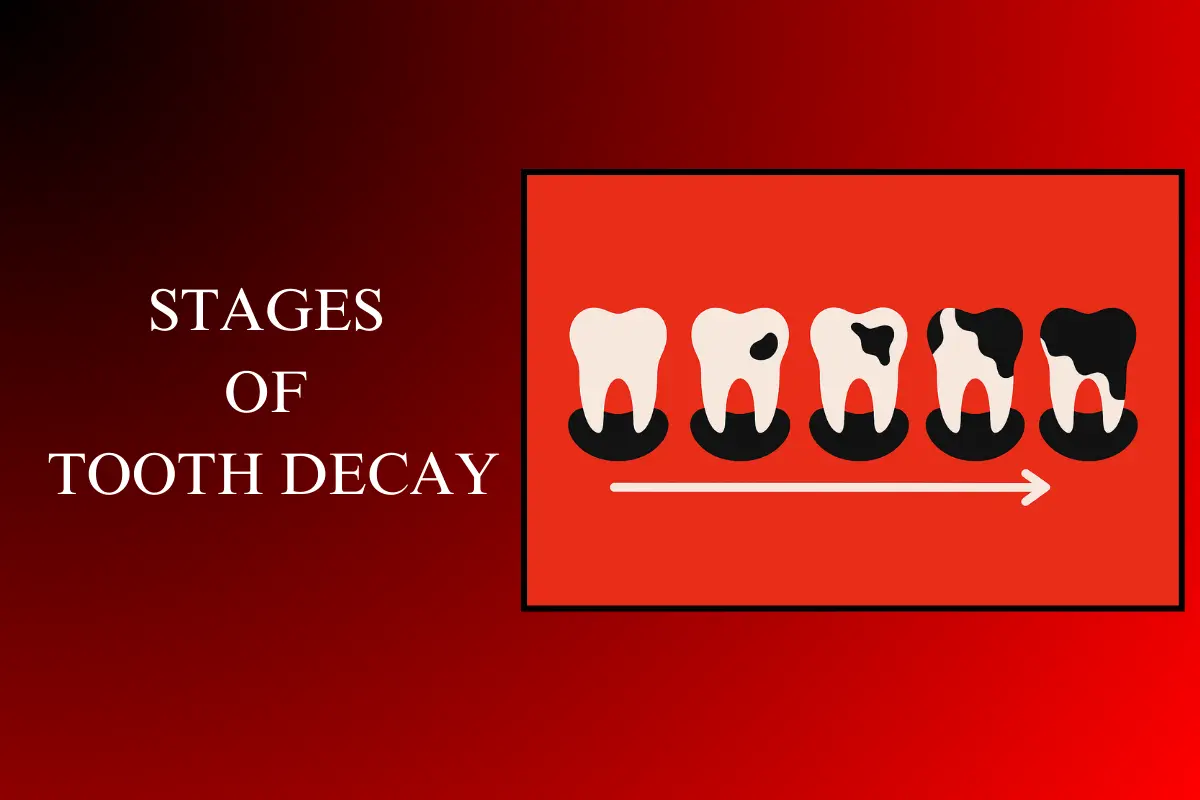
Behind most toothache is the same process: tooth decay. And it doesn’t happen overnight. There are recognisable stages of tooth decay, from a small patch of weakened enamel to a full-blown abscess.
In this guide, we’ll walk through:
- The 5 main stages of tooth decay
- What you might see and feel at each stage
- Which stages can sometimes be reversed
- When you need to see a dentist urgently in Manchester or Leeds
It’s designed to help you understand what’s happening in your mouth – not to replace a proper dental examination, so you can get the right help at the right time.
Short Summary
- Tooth decay progresses through five distinct stages, moving from the surface enamel down to the internal pulp and eventually forming an abscess.
- The first stage; initial demineralisation is the only phase that is potentially reversible through fluoride treatments and improved hygiene.
- Once decay breaks the enamel surface (Stage 2) and reaches the dentin (Stage 3), a permanent cavity has formed that requires a filling or crown.
- If decay reaches the pulp (Stage 4), it often causes throbbing pain and requires a root canal or extraction to save the tooth or stop the infection.
- Advanced decay can lead to a dental abscess (Stage 5), a serious infection involving swelling and fever that requires urgent emergency dental care.
What Are the 5 Stages of Tooth Decay? (Quick Overview)
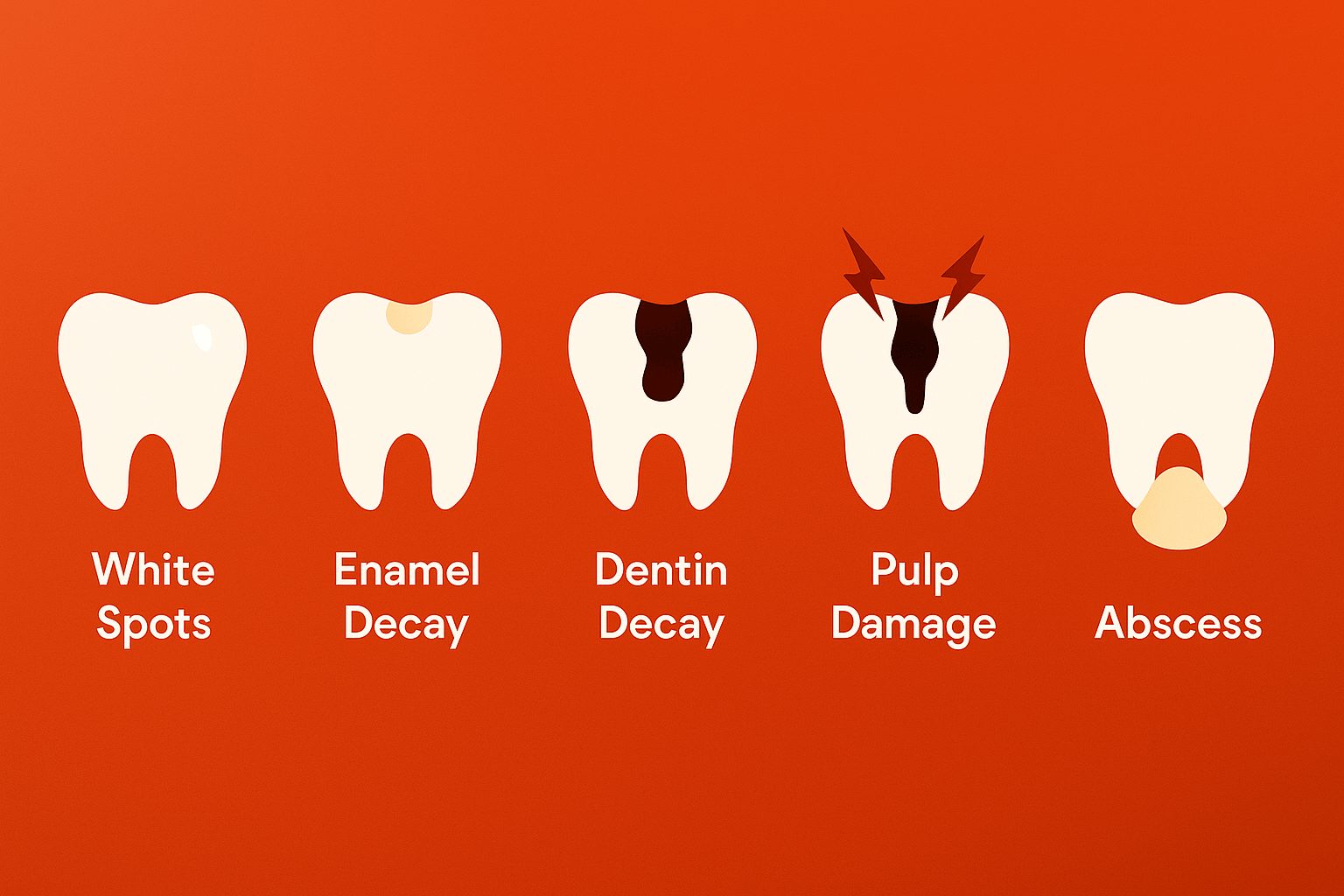
Dentists commonly describe five stages of tooth decay:
Here’s a simple summary:
| Stage | What it looks like | What you might feel | Reversible? | Typical treatment |
|---|---|---|---|---|
| 1. Initial demineralisation | Chalky white or light brown spot on enamel | Often no symptoms | Sometimes – with fluoride & hygiene | Fluoride, improved cleaning, diet changes |
| 2. Enamel decay | Visible cavity or dark spot; enamel surface broken | Possible mild sensitivity | No – damaged enamel can’t regrow | Filling or sealant, depending on size |
| 3. Dentin decay | Deeper cavity, often larger dark area | Sensitivity to hot, cold, sweet, biting | No | Larger filling, inlay/onlay, sometimes crown |
| 4. Pulp damage | Deep decay on X-ray; sometimes tooth darkening | Throbbing pain, night pain, biting pain | No | Root canal + crown, or extraction |
| 5. Abscess | Swelling, gum boil or lump, sometimes facial swelling | Severe pain, swelling, feeling unwell | No | Drainage, root canal or extraction + antibiotics if needed |
Let’s look at each stage in more detail.
Stage 1 – What Is Initial Demineralisation and Is It Reversible?
The outer layer of your tooth – the enamel – is mostly made of minerals like calcium and phosphate. In the earliest of the stages of tooth decay, acids from plaque start to pull those minerals out.
You may see:
- A chalky white or slightly brown patch on the tooth
- Often near the gumline or in grooves where plaque collects.
At this point:
- You usually don’t feel any pain.
- The enamel surface is still intact – it’s just weakened.
The good news? Early demineralisation can often be reversed. With:
- Daily brushing with a fluoride toothpaste
- Possibly a fluoride mouthwash or professional fluoride varnish
- Cutting down on frequent sugary snacks and drinks.
In Manchester and Leeds, your dentist or hygienist might spot these early changes during a routine check-up and help you turn things around before a cavity forms.
Stage 2 – What Happens During Enamel Decay?
If the early stage isn’t tackled, acids keep attacking the enamel until the surface actually breaks. A small cavity (hole) forms in the tooth.
You might notice:
- A small dark or brown spot
- A rough area you can feel with your tongue
- Maybe a bit of sensitivity to sweet or cold food.
Once there’s a true hole in the enamel, the process is no longer reversible – enamel cannot grow back.
At this stage, your dentist will usually:
- Remove the decayed enamel and
- Place a filling to seal and restore the tooth.
Treating decay at the enamel stage is usually quick, relatively simple and cost-effective compared with later stages.
Stage 3 – What Is Dentin Decay and Why Does It Hurt More?
Under the enamel lies dentin – a softer, yellowish tissue containing microscopic tubules that lead to the tooth’s nerve.
When decay breaks through the enamel and reaches dentin:
- The cavity often gets bigger more quickly, because dentin is softer
- You may feel sharp sensitivity to hot, cold, sweet food and drinks
- Chewing on that tooth can feel uncomfortable or painful.
Treatment depends on how much tooth is damaged:
- Moderate cavities: larger fillings or onlays/inlays
- Extensive damage: sometimes a crown to strengthen what’s left.
Catch it here, and the tooth can usually be saved without root canal treatment.
Stage 4 – What Happens When Tooth Decay Reaches the Pulp?
The pulp is the soft tissue in the centre of the tooth containing nerves and blood vessels. When decay finally reaches this area, we talk about pulpitis – inflammation of the pulp.
You might experience:
- Throbbing toothache, sometimes worse when lying down
- Pain that lingers after hot or cold food
- Pain when biting or chewing
- Sometimes the tooth looks darker than its neighbours.
At this stage, the pulp is often irreversibly damaged or infected. The usual options are:
- Root canal treatment – to remove the infected pulp, disinfect the inside of the tooth and seal it, often with a crown afterwards
- Extraction – if the tooth is too damaged or treatment isn’t possible.
This is usually the stage where toothache drives people in Manchester or Leeds to finally pick up the phone – even if they’ve been putting it off.
Stage 5 – What Is a Dental Abscess and Why Is It an Emergency?
If infection from the pulp spreads beyond the tooth, it can form a dental abscess – a pocket of pus, usually at the tip of the root or in the surrounding tissues.
Signs include:
- Intense, throbbing pain that may spread to your jaw, ear or head
- Swelling in your gum, face or jaw
- A pimple-like lump on the gum that may ooze
- Bad taste or bad breath
- Fever, feeling generally unwell.
At this point, it’s not just about your tooth – it’s about your overall health. Untreated dental infections can, in rare cases, spread to other areas and cause serious complications.
Treatment usually involves:
- Draining the abscess
- Root canal treatment or extraction of the affected tooth
- Antibiotics where appropriate.
If you ever notice swelling or feel unwell alongside tooth pain, that’s a sign to seek urgent care, not to wait and hope it goes away.
At Which Stage of Tooth Decay Is It Still Reversible?
A very common question is:
“Can my tooth recover on its own, or is it too late?”
Based on current evidence:
So the earlier your dentist spots a problem, the more conservative the treatment can be.
Can You Stop Tooth Decay from Progressing Between Stages?
Even if you’re past Stage 1, you can often stop things getting worse with the right care.
Your dentist may recommend:
At home, you can help by:
But it’s important not to attempt to “treat” moderate or advanced decay yourself – home methods can’t clean out infected dentin or pulp.
Why Pick Night and Day Emergency Dentist for Severe Tooth Decay Pain?
Sometimes tooth decay quietly progresses through the early stages… and then suddenly everything hurts.
If you live in Manchester or Leeds, you might need emergency help when:
In these situations, Night and Day Emergency Dentist can:
Having access to an emergency dentist means you don’t have to wait days with severe pain. You can get the situation stabilised and then decide on the best long-term solution with your usual dentist or a recommended local practice.
Get Immediate Relief!How Do Dentists Diagnose the Stage of Tooth Decay?
Dentists don’t guess – they use a combination of:
Very early decay might only be visible on an X-ray or under bright light with the tooth dried. That’s why regular check-ups matter, even when nothing hurts yet.
How Can You Prevent Tooth Decay from Reaching the Later Stages?
No matter where you live – but especially in busy cities like Manchester and Leeds where life is fast and snacks are tempting – prevention is your best friend.
Evidence-based prevention includes:
Stages of Tooth Decay in Children – Is It Different from Adults?
The stages of tooth decay in children are much the same as in adults – but baby teeth have thinner enamel, so decay can sometimes progress faster.
For children:
For parents in Manchester & Leeds, key steps are:
Frequently Asked Questions
Conclusion
Tooth decay doesn’t jump from “fine” to “disaster” overnight – it moves through clear, predictable steps. Understanding the stages of tooth decay helps you see why dentists are so keen on early check-ups: a tiny white spot might only need fluoride and better brushing, while leaving things until there’s throbbing pain or swelling can mean root canal treatment, an abscess, or even losing the tooth.
The key message is simple:
- Early stages can often be managed with minimal treatment.
- Later stages are still treatable, but they’re more complex, more uncomfortable, and more expensive.
If you’re in Manchester or Leeds and you’ve noticed sensitivity, food catching, dark spots, or ongoing toothache, it’s much better to let a dentist take a look now rather than wait until it becomes an emergency. With the right advice, timely treatment, and good home care, most tooth decay problems can be controlled.